Friday, 24 May 2013

flora and fauna in my un-trendy autumn garden


I'm definitely out of sync with trendy, fashionable gardeners. What's cool is to grow your own fruit and vegetables. It seems people just don't see the point of an ornamental garden. I constantly get unsolicited, well - meaning suggestions and advice on growing potatoes or lemons or lettuce. I acknowledge the suggestions politely, then keep on doing what I do - growing pittosporum, lavender, lomandra and whatever else adds to the garden picture and can do without supplementary watering.

Even cooler than growing your own fruit and vegetables in your own garden, is to do it with other people in a community garden. Again, I fail the fashion test. For me gardening means solitude. I love gardening alone. Don't get me wrong. I'm not always unsociable - but I am when I'm gardening.

Autumn is in free fall, with huge piles of leaves in the street. A Council truck picks them from time to time, but I get in first. I happily gather them up and bring them home to provide a cosy winter blanket for the whole garden.


There are lots of flowers in the autumn garden.

Borage
Valerian
Verbena rigida 'Polaris'
Acacia iteaphylla

Eucalyptus leucoxylon 

Correa pulchella 'Little Cate'
Heliotrope Cherry Pie
Dietes grandiflora
Loquat

And then there are the invertebrates - uninvited, mostly welcome contributors to the biodiversity of the little ecosystem that is my garden ...


This female Redback Spider is one of Australia's most dangerous venomous spiders, but it's not aggressive. So, as long as I don't accidentally touch it, I feel safe.  Legendary Australian country music writer and singer Slim Dusty wrote a song called Redback on the Toilet Seat. In an outdoors lavatory ('dunny') you'd better watch out so you don't inadvertently sit on a redback!


The sticky fluffy substance on the bottom branches of the Crabapple looks like cotton wool. Inside and around the 'cotton wool' are tiny black insects. I think they may be woolly aphids, mealy bugs or another kind of scale insect. Aphids and scale insects are sap sucking insects that excrete a substance called honeydew. Honeydew attracts sooty mould, a fungus. I wonder whether this white substance is also a fungus. I didn't notice any eggs in it.


Another fascinating backyard nature puzzle is just what kind of creature made this large, loose, untidy web?


This European wasp hooked its back legs onto a leaf and proceeded to preen and clean itself. Either I need a better macro lens or I need to learn how to use it better. But you get the idea I think ...

Wednesday, 15 May 2013

birds in the garden: a dismal update


I miss the jubilant rowdy morning chorus I used to hear each morning. These mornings I'm lucky if I hear half a dozen birds greeting the day. Sometimes it's eerily silent, apart from traffic noise. Other mornings I might just hear pigeons cooing. It's very sad.

Recently there have been more introduced bird species than native birds in the garden. I don't mind blackbirds and pigeons so much. It's the Indian Myna birds I take exception to. They have an unpleasant voice and are nasty, aggressive and possessive of their territory, often chasing other birds away.

Indian Myna birds were introduced to Australia in the 1860s to control insects in market gardens. Since then they have flourished, adapting to a wide variety of conditions, and are hated and regarded as pests.

Lismore, a town in New South Wales, recently declared war on the species.

Indian Myna bird in my garden
Blackbird

The Spotted Dove originates in Southeast Asia and India. It was introduced to Melbourne in the 1860s and is now very common. They tend to walk around the garden, usually in pairs, foraging for seeds.
Spotted Dove

One native bird that does frequent the garden is the Red Wattlebird, one of the largest of Australian honeyeaters. Wattlebirds feed on nectar by probing flowers with their thin curved beaks. Unfortunately they are also aggressive, and attack other nectar feeders to protect their food source.

Red Wattlebird
Another Red Wattlebird, showing its red wattle


This beautiful Eclectus parrot visited my garden, but it's not exactly wild. The parrot's name is Ruby, and she visited with her owner J. She is very attached to J, and the feeling is reciprocal. Sigh, it's so much easier to take photos of tame birds!


Brown Thornbill (Wikipedia)

There are also flocks of tiny chittering birds that I never manage to capture with my camera because they are continually, rapidly darting around.


Monday, 6 May 2013

living with uninvited non-humans

D works for a pesticide company and tells interesting stories about pesticide use and the relationship between humans and wildlife. I met D when the sounds and smells of rats in the roof became too much to bear. 

D explained that the poison used to kill rats is the drug Warfarin. Warfarin is a drug used in medicine to thin patients' blood to help avoid stroke. Bleeding internally, the rats die a slow and agonizing death. But this is thought preferable to using a fast acting poison because the rats go elsewhere to die and rot. There's not much sympathy for wild rats among humans. 


D doesn't mind too much about killing rats, but sometimes he doesn't feel good about his work.  A woman recently called in a panic because she saw a Gecko in the garden. In this case D was happy he couldn't kill it because it's a species protected by law. But he has to do his job when he gets requested to kill spiders - even if he is asked to spray the garden near the house.

Marbled Gecko Christinus marmoratus found in my garden

Saturday, 27 April 2013

human - botanical relationships


When you garden in the same place for a long time, you get to know your plants very well. In fact, you could say that you develop longterm relationships with them.  These relationships are all different. With the Wisteria, I have long given up banishing this plant from the garden. It's a relationship characterized by a sullen fatalistic acceptance on my part that it's here to stay. When I see it I remove whatever I can, which is not much. The Acanthus is similar. It always comes back, but it's not as annoying as the Wisteria.

Sunday, 21 April 2013

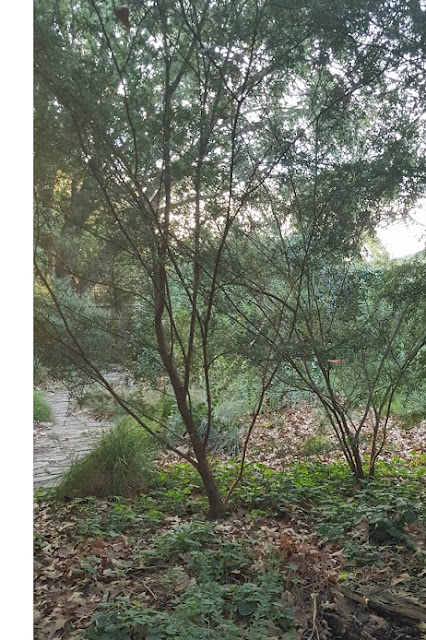
seeing the garden as it will be, and tree following

There's something to be said for buying plants as large as you can afford. It's sensible advice!  But when I'm buying plants, I prefer small, reasonably fast growing young plants.  I love watching them grow bit by bit to gradually fill their allotted spaces.  When small, they tend to grow quicker and healthier than larger specimens with already developed root systems.

Because I don't cosset my plants, there is always a chance they won't survive, and if I invested a lot of money I would get anxious. Many of the plants I want are not available anyway as large specimens.

Gardens exist in time.

Popular Posts