Thursday, 29 December 2011

nature books for children

Here are two superb books with two very different approaches to helping children learn about and appreciate the natural world.

One of them is a reprint of a book first published in 1923.  If you look very hard at the pictures and the pop up illustrations, this book may help you find a fairy, hiding in a tree, flower or among butterflies.


It tells you what a tree fairy looks like so you know what to look for.


It explains that fairy houses are not easy to see, so you must watch very carefully for hidden entrances.


Don't forget to keep a close eye on butterfies, because fairy wings resemble butterfly wings.


In a garden full of flowers it is likely that there are many fairies.


The other book has been meticulously researched by its Australian author. It has wonderfully detailed pictures and information about the animals, birds, spiders and insects that inhabit the teeming dramatic hidden world of leaf litter.


This book has flaps to lift that show you what is underground.


Under this flap we see a cicada nymph quietly sucking sap from a tree root. It's almost fully grown and ready to crawl out of the leaf litter.


Lots of animals are having babies now that spring has arrived.


A brown snake has just woken from hibernation. It's hungry, smells mice with its flickering tongue,  slides down the burrow, catches the father mouse and swallows it whole.


Now it's summer, and insects split their pupal cases and nymph skins and change into butterflies, moths, praying mantises and lots more kinds of insects. A southern brown tree frog climbs back into the tree for safety after it was knocked to the ground by a bird looking for insects.


There's so much to see and so much to learn in the Things to Find section. Some of these Things to Find are tiny and subtle. For example, on one page can you spot a half chewed leaf and the katydid that ate it? And a fascinating fact if you don't already know it or have forgotten: Like grasshoppers katydids hear with their front legs.


So there you have it. You want science based nature? You got it. You want fairies in the garden? You got it. But why choose? Anything that helps children appreciate nature is worth looking at.

Barker, Cicely Mary (2007) How to Find Flower Fairies. Frederick Warne.
Tonkin, Rachel (2006)  Leaf Litter. Angus and Robertson.

Thursday, 22 December 2011

lost in the garden

Once upon a time there were four bears called Mummy Bear, Daddy Bear, George and Georgina. They lived in a very small house with a very large garden.

Every morning after breakfast George and Georgina went out into the garden to play.
One day they didn't come home for lunch.

Mummy and Daddy Bear were very worried. They went into the garden to look for their children.
In the front garden they met a bird called a Guinea Fowl. Have you seen George and Georgina? they asked.
I did see the Teddy Bears early today
They stayed and they played
Then they went on their way.
On the wall of the house they saw some flying ducks. Have you seen George and Georgina? they asked one.
I did see the Teddy Bears early today
They stayed and they played
Then they went on their way.
In the back garden they met a man playing a clarinet. Have you seen George and Georgina? they asked. But the man just kept playing his clarinet and didn't answer.
Further down the path they met a dog called Potter. Have you seen George and Georgina? they asked. But Potter was watching a Monarch butterfly and didn't hear them.
Next they met some rabbits with blue eyes. Have you seen George and Georgina? they asked. 

We did see the Teddy Bears early today
They stayed and they played
Then they went on their way.
By this time it was starting to get dark, and Mummy and Daddy Bear were more worried than ever.
Right at the end of the garden near the compost heaps they met a kind and wise gnome.  Have you seen George and Georgina? they asked.  The gnome didn't answer. He just pointed to the tall Willow Myrtle tree at the bottom of the garden.
Behind the tree they found the two little bears, lost and hungry and thirsty.
So they all went home together and had some delicious food before they went to bed.
 Goodnight, little bears ...

Tuesday, 13 December 2011

Garden Bloggers Bloom Day December 2011

I appreciate Carol from May Dreams Gardens hosting this meme, but I am interpreting blooms very widely, to mean anything that's looking good and / or has photographed well.

Summer's started, and as usual, there has been a wide variety of gardening  conditions: hot, cold, wet, dry and everything in between. These photos were taken on a bright sunny day, when there were shadows to contend with, a photographic challenge.


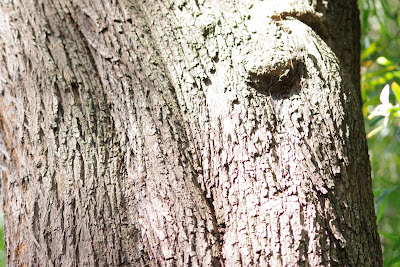
This is a portion of the trunk of the Grand Old Tree at the bottom of the garden, the Australian willow myrtle.  Unlike the other, newer trees, this one has had the chance to age and weather characterfully. I hope to emulate it in my ageing journey.


The seedpods of the blue fescue hang over the path, marking the progress of time and growth, and as attractive as the blue grass itself.


This photo reminds me of a post impressionist painting, with dots of coloured light. This is the bed with a profusion of flowers - valerian, opium poppies, society garlic, Californian poppies, catmint.


The feiijoa tree is starting to flower, and fruit.  The fruit will be shared by humans and wildlife.


Here is a tangle of leptospermums.


The pink penstemons, verbena rigida polaris and the opium poppy flower at the same time against the new bamboo fence protecting the deck and the house, from the hot western afternoon sun.


In the front garden the plumbago that frames the picture is starting to flower, so the frame gradually changes from green to blue and green.


The smoke bush with its soft, floaty seed pods, lights up the shade.


I used to grow santolina for its foliage, and when it flowered, cut the flowers off. Now I am a grownup and much more laid back gardener, I appreciate the yellow buttons.


The divine pink flowers of the opium poppies are replaced by the seed pods, just as attractive and interesting too.

Orange and pink wallflowers, among my top favourite flowers.


This buddleia Silver Anniversary, is probably the tenth shrub trialled in this corner of the front garden. I think it's finally right, and associates beautifully with another of my fave flowers, orange pokers, called Shining Sceptre.

Thursday, 8 December 2011

influence of cyberfriends and new mulching method


I used to like agapanthus. I preferred the softer smaller ones, and I liked the ones with darker blue flowers. I knew some of them were noxious weeds but I wasn’t sure which ones were which, so I continued to grow them. It was so easy to divide them to fill gaps, and they were totally reliable.

Then, suddenly, a couple of weeks back, I stopped liking them. They just looked wrong. Why the sudden shift? I wondered.  The answer is: the influence of two of my cyberfriends.  Phoebe, whose blog is called Ballynoe Cottage, gardens in my home town of Melbourne, and Diana, of Elephant's Eye fame, gardens in South Africa. 

In a recent post Phoebe indicated that she hated agapanthus. I was startled. I started to look at aggies differently. It’s the time of the year where they’re flowering and I see them everywhere.    
                                                                                                                                  
Round about the same time that Phoebe made her comment, Diana featured some of her native plants in her blog, including agapanthus. They looked great in her context. I’m not going to run away and join one of the Indigenous Plants Only cults.  It’s just that I’ve gone off Agapanthus. So they have to go – well, most of them anyway.

The other thing that irritated me, for a different reason, were the Canary Island wormwoods. Like aggies, they're great when you want something reliable to fill a space. But they grew too big. They hid their neighbours and spoiled the flow and serenity of the overall garden picture.

I prefer temporary gaps in the garden to plants that upset the overall harmony of the design.  Today was the first day in over a week that I had time to garden. The temperature soared to over 30°. You had to be obsessional or an idiot to make garden changes today. I was both.

The plants wilted at me accusingly. The lovely rich soil was suddenly exposed to hot sun, and I imagined lots of earthworms diving for cover. Hot and tired, I invented a new method of mulching.  It’s called Mulching for Lazy Gardeners, or MLG for short. You just chuck the cuttings and uprooted plants straight onto the bare earth. I can't say it looks lovely. But it looks better than plants that look out of place, and it looks heaps better than bare earth soaking up the heat. And it meant I could go inside and fall in a hot heap.

Popular Posts